
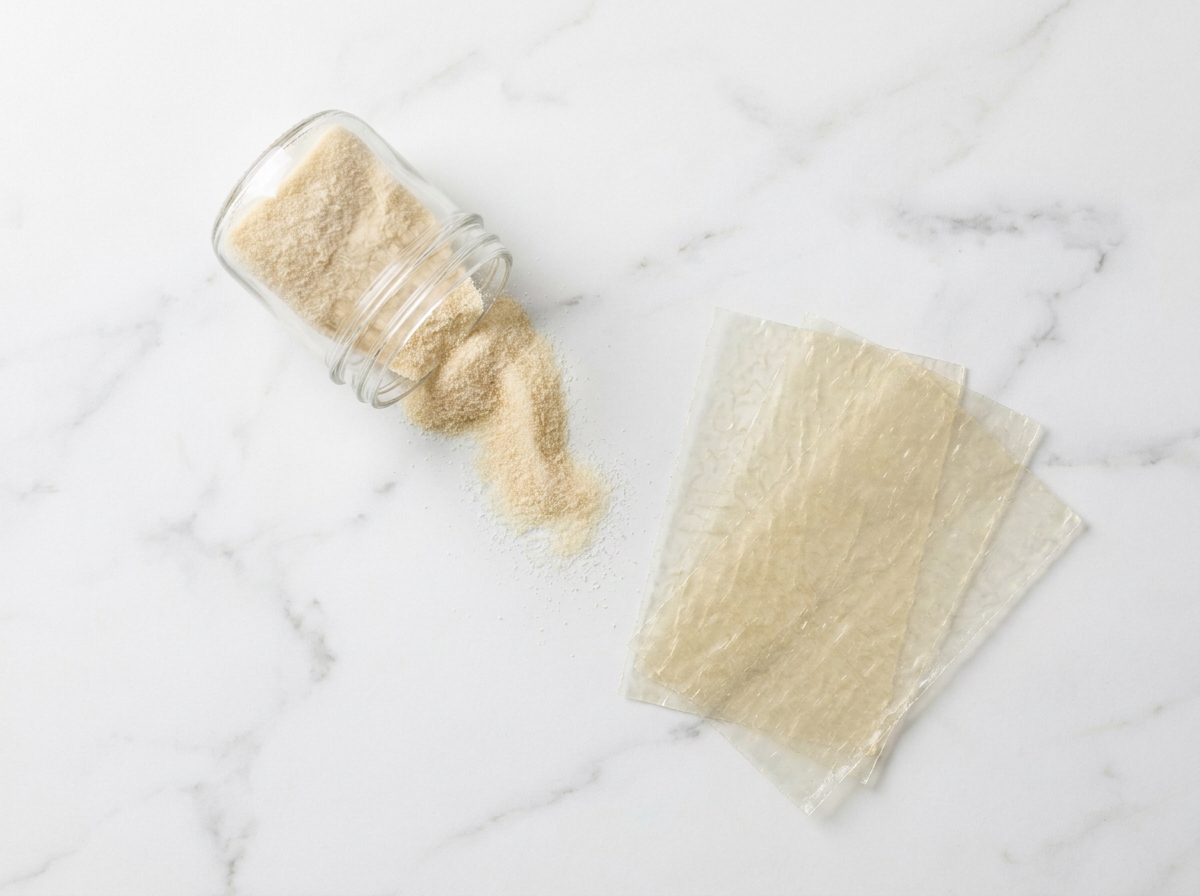
How is gelatin made? It’s a question most people never think to ask — you dissolve it into a mold, spoon it from a cup, stir it into your morning wellness drink — and yet the process behind that humble powder is surprisingly fascinating.
Gelatin is one of those ingredients that looks almost like magic in its final form, but the science behind it is methodical, well-documented, and worth understanding — especially if you’re using it regularly for wellness or weight loss recipes.
In this guide, we’re walking you through the entire production process — from raw animal collagen all the way to the translucent powder or sheet sitting on your kitchen shelf. No jargon, no fluff.
What Is Gelatin, Really?
Before we get into how it’s made, let’s quickly establish what gelatin actually is.
Gelatin is a protein derived from collagen — a structural protein found naturally in animal connective tissue, bones, and skin. When collagen is exposed to heat and water over time, it breaks down into gelatin. The result is a neutral, nearly flavorless ingredient that dissolves in hot liquid and sets into a firm gel when cooled.
It’s not a synthetic additive or a chemical compound. It’s essentially cooked collagen in concentrated, shelf-stable form.
Two main animal sources are used commercially:
- Bovine (beef/cattle): bones and hides — the most common halal-certified source
- Porcine (pork): skin and bones — widely used in the conventional food industry
- Fish: scales and skin — used in kosher and some halal products
| 🌿 🌿 Hannah’s note: At jelloandwellness.com, all recipes use bovine or fish gelatin. We never use pork-derived products. If you’re unsure about a brand, check out our guide → Is Gelatin Pork? How to Read Labels the Right Way |
How Is Gelatin Made? The Full Step-by-Step Process
Commercial gelatin production follows a consistent sequence of steps. Here’s exactly what happens.
Step 1 — Raw Material Collection and Pre-Treatment
The process starts with animal by-products — primarily cattle bones and hides, or pork skin. These materials are collected from slaughterhouses and meat-processing facilities as food-grade by-products.
At this stage, the raw materials go through a rigorous cleaning process:
- Bones are defatted: excess fat is removed using hot water or solvents
- Hides and skins are washed to eliminate surface contaminants
- Materials are inspected for quality and food-safety compliance
This pre-treatment step is critical. No shortcuts here — the cleaner the raw material, the purer the final gelatin.
Step 2 — Demineralization (For Bone Gelatin)
If the source material is bones (ossein gelatin), an extra step is required before extraction: demineralization.
Bones are soaked in a diluted hydrochloric acid solution for several weeks. This process removes the mineral salts — primarily calcium phosphate — from the bone structure, leaving behind the soft collagen matrix.
The result is called ossein: soft, pliable bone collagen, ready for the next step.
| 💡 Note: Hides and skins don’t require demineralization because they don’t contain mineral-dense bone tissue — they go straight to the conditioning step. |
Step 3 — Conditioning (Acid or Alkaline Treatment)
This is where bovine and porcine gelatins diverge in production method.
| Treatment Type | What Happens + Which Source |
| Acid Process (Type A) | Material is soaked in dilute acid (usually sulfuric or hydrochloric acid) for 10–48 hours. Most commonly used with porcine skin. Produces a higher isoelectric point gelatin. |
| Alkaline Process (Type B) | Material is treated with lime (calcium hydroxide) for 8–12 weeks — a longer, gentler process. Most commonly used with bovine hides and bones. Produces a gelatin with a lower isoelectric point, often preferred for food and pharmaceutical applications. |
The conditioning step breaks down the cross-links between collagen molecules, making it easier to extract gelatin in the next phase.
Step 4 — Hot Water Extraction
This is the heart of the gelatin-making process.
The conditioned collagen material is placed into large vessels and treated with hot water — typically between 50°C and 100°C (122–212°F) — in a series of sequential extractions.
Each extraction produces a different grade of gelatin:
- First extraction (lower temperature, shorter time): highest gel strength, lightest color, premium grade
- Subsequent extractions (higher temperature, longer time): progressively lower gel strength, darker color
The extracted gelatin solutions — called extraction broths — are then filtered to remove residual bone or tissue particles.
| 🔬 Science corner: The gel strength of gelatin is measured in Bloom degrees. A 250 Bloom gelatin sets firmer than a 100 Bloom. Knox unflavored gelatin is typically around 225–250 Bloom — strong enough to set firm desserts without becoming rubbery. |
Step 5 — Filtration and Purification
The gelatin broth is far from ready at this point. It still contains fat, mineral particles, and other impurities.
Multiple filtration stages follow:
- Coarse filtration: removes large particulates
- Fine filtration through membrane systems: removes smaller impurities
- Activated carbon treatment: decolorizes and deodorizes the solution
- Ion exchange: adjusts the pH and removes any residual ions from the conditioning step
After purification, you have a clear, pale-yellow to colorless gelatin solution — still liquid, but clean.
Step 6 — Evaporation and Concentration
The purified gelatin solution is mostly water at this stage — typically only 3–5% gelatin by weight.
It’s fed into large evaporators that remove water under low pressure and moderate heat. This prevents degradation of the protein chains while concentrating the gelatin to 25–40% solids.
The concentrated gel is then chilled on stainless steel belts or drums until it solidifies into thin sheets or noodles.
Step 7 — Drying
The solidified gelatin noodles or sheets pass through a carefully controlled drying tunnel.
Air temperature and humidity are precisely regulated — too hot and the gelatin degrades; too humid and it won’t dry properly. The process typically runs for 3–6 hours depending on thickness.
The final moisture content is 10–13%, which gives gelatin its characteristic shelf-stable, powdery texture.
Step 8 — Milling, Blending, and Packaging
Dried gelatin sheets are milled into the powdered form most home cooks recognize. Different particle sizes are produced for different applications:
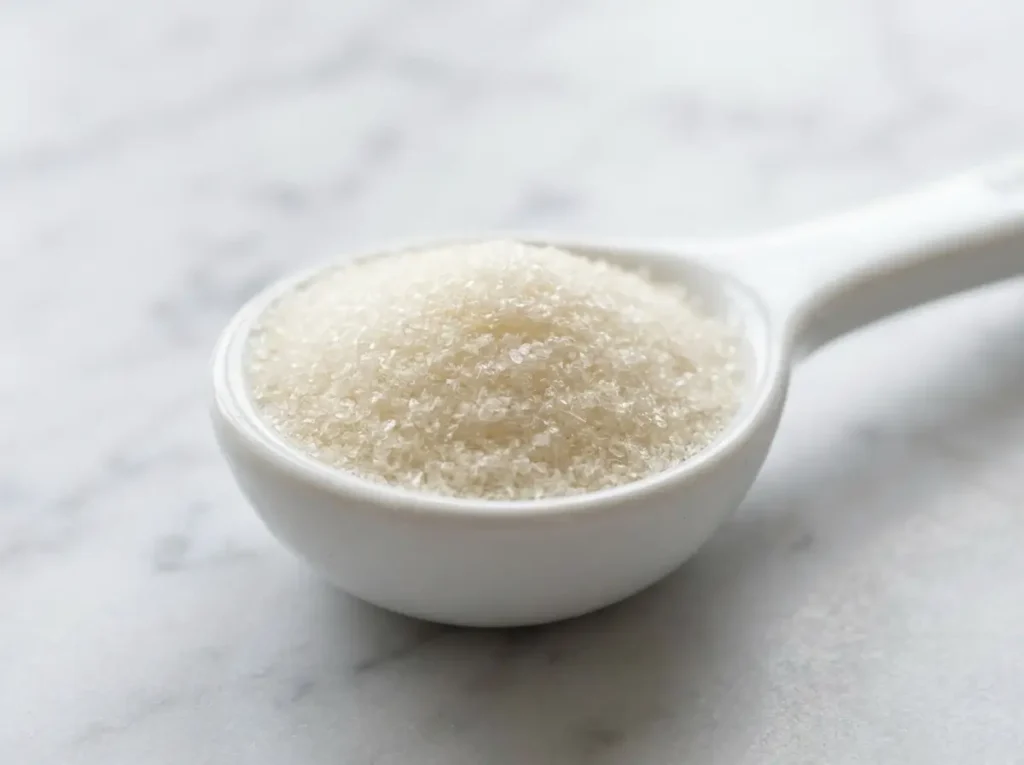
- Fine powder: fastest-dissolving, used in most home-cooking gelatins (Knox, Great Lakes unflavored)
- Coarse granules: used in industrial food processing
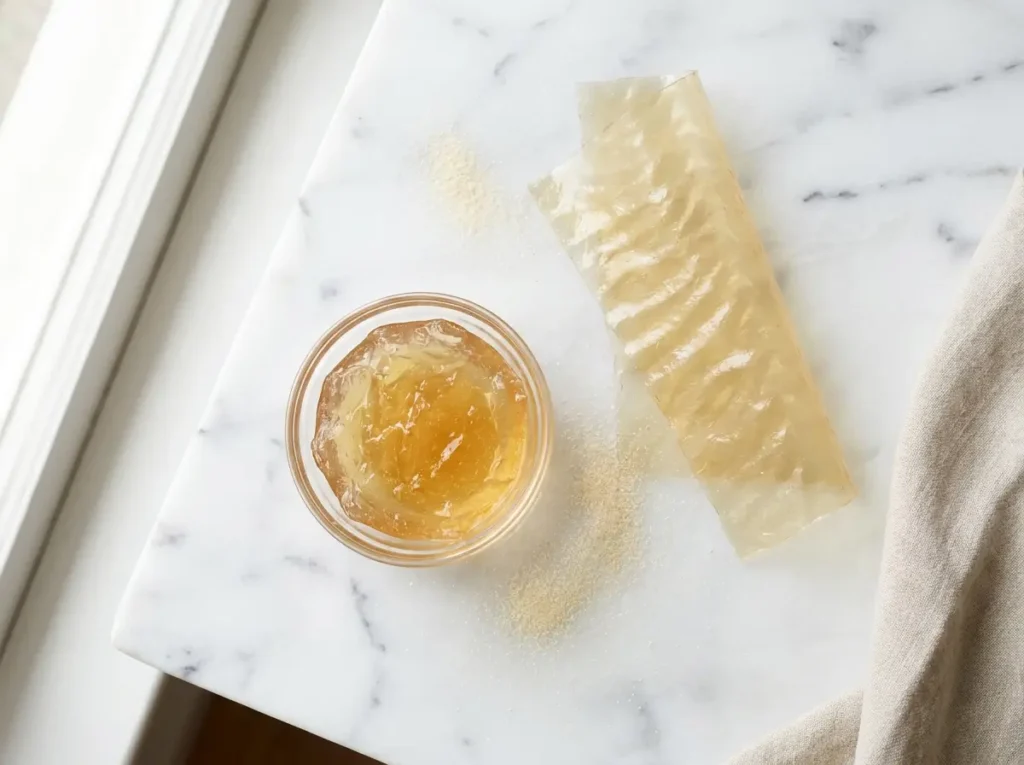
- Leaf/sheet gelatin: dried into flat, transparent sheets — preferred by professional pastry chefs
Batches from different extraction cycles are blended to achieve a consistent Bloom strength, then tested for quality before packaging.
Types of Gelatin: What the Labels Actually Mean
Not all gelatin is the same. Here’s a quick breakdown of what you’ll find at the store or online.
| Type | Key Details |
| Unflavored Gelatin (Type A or B) | Pure gelatin with no added sugars or flavors. Most versatile for cooking and wellness recipes. Knox and Great Lakes are the most common US brands. |
| Flavored Gelatin (Jell-O etc.) | Gelatin + sugar + artificial flavors + colorants. Not the same as unflavored. Nutrient profile very different. |
| Hydrolyzed Collagen / Collagen Peptides | Gelatin that’s been further broken down into smaller peptides. Doesn’t gel. Dissolves in cold water. Different applications. |
| Leaf / Sheet Gelatin | Same protein as powder, just in sheet form. Gold, silver, and platinum grades differ in Bloom strength. 1 sheet ≈ 1 tsp powder (varies by brand). |
| Halal / Kosher Gelatin | Certified bovine or fish-sourced. Same process — just with stricter sourcing and slaughter standards. Look for IFANCA or OU Kosher marks. |
Is the Production Process Safe? What You Should Know
It’s a common concern: if gelatin comes from animal bones and hides, is the process actually safe and clean?
The short answer is yes — provided the gelatin is food-grade and certified.
Here’s why:
- The acid or alkaline conditioning step effectively eliminates most bacterial pathogens
- The high-temperature extraction kills any remaining microorganisms
- Multiple filtration and purification steps remove chemical residues from the conditioning agents
- Food-grade gelatin is subject to regulatory oversight (FDA in the US, EFSA in Europe)
The World Health Organization and FDA have both concluded that properly processed gelatin poses no BSE (mad cow disease) risk, even when derived from bovine sources, because the extraction process is sufficient to inactivate prions.
| ⚠️ One thing to verify: always buy from reputable brands that disclose their source (bovine, porcine, or fish) and carry third-party certifications (halal, kosher, organic). This protects both your health and your dietary preferences. |
From Factory to Your Kitchen: How to Use Gelatin Properly
Understanding how gelatin is made also helps you use it better. A few practical pointers:
Always bloom first: Sprinkle gelatin over cold water (1 tablespoon water per 1 teaspoon powder) and let it sit 5 minutes before adding to warm liquid. Skipping this step causes clumping.
Don’t boil: Temperatures above 90°C (195°F) begin to break down gelatin’s protein chains, weakening its gelling power. Dissolve in warm (not boiling) liquid.
Acid weakens gel strength: High-acid ingredients like fresh pineapple, kiwi, and papaya contain proteases (enzymes) that break down gelatin. Always cook these fruits before adding to gelatin recipes.
More gelatin = firmer set: Standard ratio: 1 teaspoon (≈2.5g) of unflavored gelatin per 1 cup of liquid for a firm set. Use half that for a softer, spoonable texture.
| 👇 👇 Ready to put it to use? Try these recipes: → Does Gelatin Have Protein? What You Actually Get Per Serving — our pillar guide with the most popular wellness applications → Jillian Michaels Gelatin Recipe — the viral gelatin trick, made halal-friendly → Bariatric Gelatin Recipe — soft-food stage, post-op approved |
Frequently Asked Questions
Is gelatin vegan?
No. Gelatin is derived from animal collagen and is not suitable for vegans or vegetarians. The closest plant-based alternatives are agar-agar (derived from red algae) and pectin (derived from fruit). Both gel differently — agar sets firmer and at room temperature; pectin requires sugar and acid to set properly.
Is gelatin the same as collagen?
They come from the same protein source, but they’re not identical. Collagen is the raw, native protein found in animal connective tissue. Gelatin is partially hydrolyzed collagen — meaning heat has broken some of the protein bonds. Hydrolyzed collagen (collagen peptides) is collagen that’s been broken down even further, to the point where it no longer gels.
How long does it take to make gelatin commercially?
The full industrial process — from raw material to packaged product — typically takes 3 to 8 weeks, primarily because the alkaline conditioning step for bovine gelatin (Type B) requires 8–12 weeks. Acid-process gelatin (Type A, mostly porcine) moves faster at 10–48 hours for conditioning, making the total process closer to 2–3 weeks.
What’s the difference between Knox gelatin and Great Lakes gelatin?
Both are unflavored, food-grade powdered gelatins. Knox is the most widely available brand in US grocery stores and is typically bovine-sourced (check current packaging — sources can change). Great Lakes is often marketed as grass-fed bovine, which appeals to wellness-focused consumers. Both work well in the recipes on this site.
Can gelatin go bad?
Properly stored unflavored gelatin powder has a very long shelf life — often 2–4 years if kept in an airtight container away from moisture and heat. The drying step in production reduces moisture to 10–13%, which inhibits microbial growth. If your gelatin has absorbed moisture and clumped, it may still work, but the gelling strength may be reduced.
Sources
2. Haug IJ & Draget KI (2011). Gelatin. In Handbook of Food Proteins. Woodhead Publishing.
3. U.S. FDA — Substances Generally Recognized as Safe: Gelatin (21 CFR § 182.70).
About Hannah
| Hannah is the founder of jelloandwellness.com and a longtime wellness food enthusiast. After years of exploring the science behind everyday pantry staples, she built this site to share practical, research-backed guides for women who want to eat smarter — not harder. Every article on this site is researched, tested, and written with your real kitchen in mind. |