
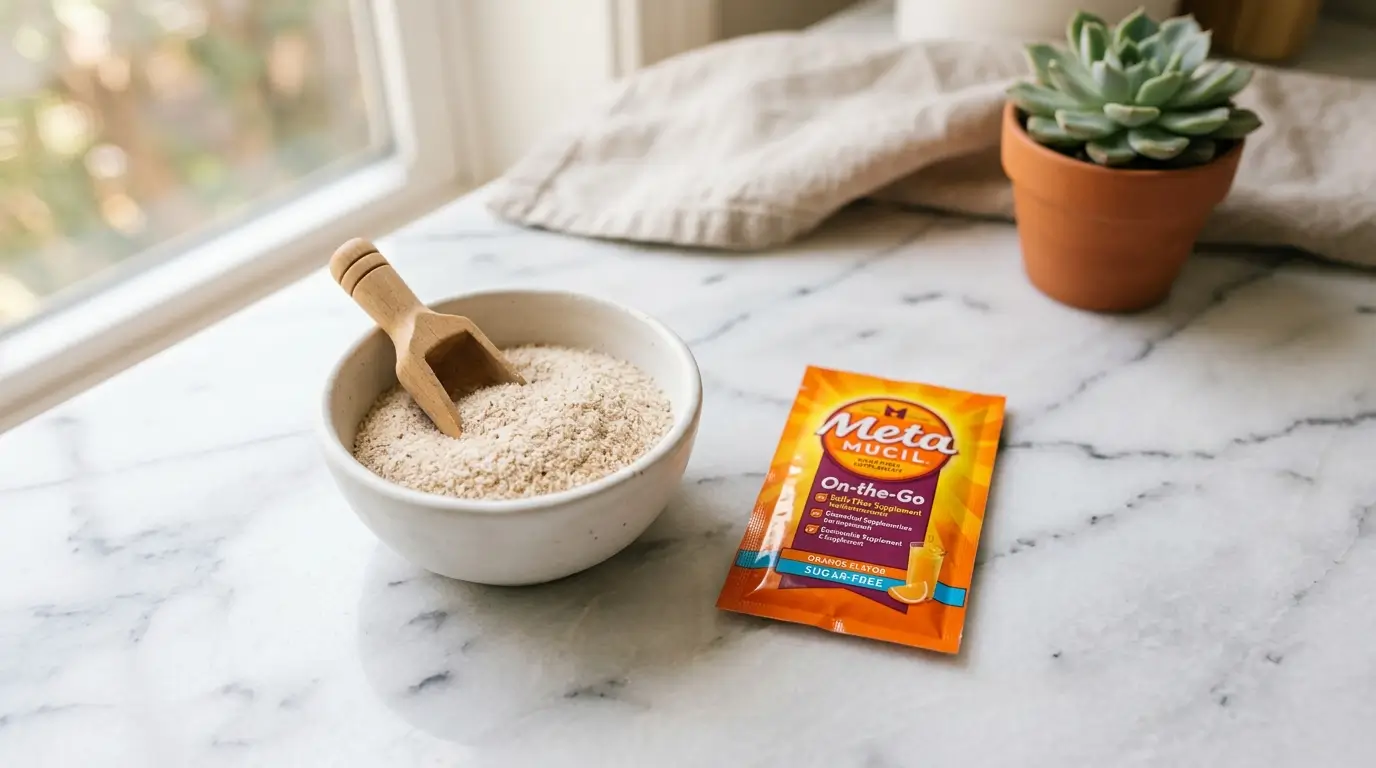
Psyllium husk vs Metamucil is a question worth asking carefully, because Metamucil is built entirely around psyllium husk — but “made with psyllium husk” and “mostly psyllium husk” are two very different things once you read the actual label. Here’s what’s really in each, gram for gram.
Short answer: Metamucil is psyllium husk, so the active fiber is the same. The products are not the same, though. Pure psyllium husk powder is only the husk, while Metamucil adds sugar or a sweetener, flavoring, and dye. One serving of Metamucil gives you 2.4g of soluble fiber, versus about 6g in a tablespoon of pure powder.
| ⚕️ Medical Disclaimer This article is for informational purposes only and does not constitute medical advice. The information shared here is not designed to treat, prevent, or cure any condition. If you are pregnant, breastfeeding, taking medication, or managing a health condition — including diabetes or phenylketonuria (PKU) — speak with a licensed healthcare provider before adding any new fiber supplement to your diet. |
This is a different comparison from our glucomannan vs psyllium husk guide, which looks at two different fiber types. This one stays within psyllium husk itself — pure powder versus the best-known branded version.
What’s Actually in Each One (Psyllium Husk vs Metamucil)

| Product | Ingredients | Soluble Fiber Per Serving |
|---|---|---|
| Pure psyllium husk powder (e.g., NOW Foods) | Psyllium husk only | ~6g per tablespoon |
| Metamucil Orange Smooth, Real Sugar | Sucrose, Psyllium Husk, Citric Acid, Natural and Artificial Orange Flavor, Yellow 6 | 2.4g per 2-tbsp serving |
| Metamucil Orange Smooth, Sugar Free | Psyllium Husk, Maltodextrin, Citric Acid, Natural and Artificial Orange Flavor, Aspartame, Yellow 6 | 2.4g per 2-tbsp serving |
The gap is the whole story here. A tablespoon of pure psyllium husk powder is essentially all fiber. A serving of Metamucil’s Real Sugar version packs in 16g of added sugar (32% of a daily value) alongside its psyllium — meaning you’re getting real fiber, but also a meaningful dose of sugar you didn’t necessarily plan on. The Sugar Free version swaps that sugar for maltodextrin and aspartame instead, which isn’t automatically the “cleaner” choice — it’s a different trade-off, not the absence of one. Both branded versions also contain Yellow 6, an artificial dye, and artificial orange flavoring; pure psyllium husk powder contains neither.
Do You Get the Same Fiber Benefit?
When comparing psyllium husk vs Metamucil on fiber content alone, the active ingredient doing the work is the same psyllium husk in both cases, and the FDA’s authorized health claim (7g/day of soluble fiber from psyllium husk to help reduce coronary heart disease risk) applies to the fiber itself, not to any particular brand. What changes is how much of the actual dose you’re getting per scoop, and what else comes along for the ride.
Because Metamucil dilutes its psyllium with other ingredients, you need more scoops — and more sugar or maltodextrin/aspartame along with them — to hit the same 7g target that a pure powder reaches in roughly one heaping tablespoon.
The Real Cost Comparison
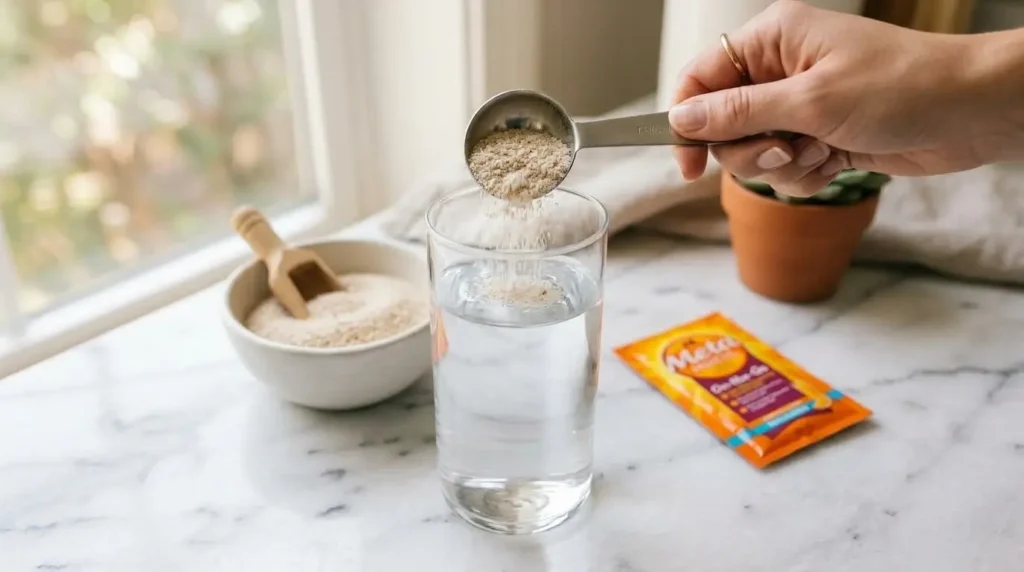
Based on current retail pricing, a pure psyllium husk powder runs roughly $0.75–$0.95 per ounce, delivering close to 6g of soluble fiber per tablespoon with nothing else in the mix. Metamucil’s 30-serving Real Sugar package runs about the same per ounce — but each serving only supplies 2.4g of soluble fiber, meaning you’re paying a similar price per ounce for roughly 40% as much active fiber, with 16g of added sugar as the rest of the weight.
In practical terms: hitting the FDA’s 7g/day target costs noticeably less with pure psyllium husk powder than with either Metamucil version, once you account for how many scoops of each you actually need.
Why Would Anyone Choose Metamucil, Then?
Taste and convenience are the honest reasons. Pure psyllium husk powder is unflavored, gritty, and thickens quickly — some people find it unpleasant to drink straight. Metamucil’s sugar or sweetener and orange flavoring exist specifically to make a daily fiber habit easier to stick with, and pre-measured servings take the guesswork out of dosing. That’s a real, legitimate trade-off — it’s just not a “better fiber” trade-off, it’s a palatability one.
Who Should Be Careful
- Diabetes or blood sugar management: the Real Sugar version adds 16g of sugar per serving — factor that into your daily intake, or choose the Sugar Free version or pure powder instead.
- Phenylketonuria (PKU): the Sugar Free version contains aspartame and lists phenylalanine content on the label — avoid if you have PKU.
- Artificial dye sensitivity: both Metamucil versions contain Yellow 6; pure psyllium husk powder does not.
- Anyone starting fiber supplementation: increase your dose gradually and always take psyllium — in any form — with a full glass of water to avoid choking or blockage risk.
Frequently Asked Questions
What happens if I take Metamucil every day?
Taken consistently with enough water, daily psyllium husk (in Metamucil or pure form) is generally associated with more regular bowel movements, modest cholesterol reduction, and steadier post-meal blood sugar. Start with one serving and increase gradually to avoid bloating.
Why does Metamucil only come in orange flavor?
Metamucil offers other flavors and unflavored options too, but orange is the original and most widely stocked flavor, which is why it’s the version most people encounter first.
How long after taking Metamucil will you poop?
Effects vary, but psyllium husk typically takes 12 to 72 hours of consistent use to noticeably affect bowel regularity — it’s a fiber supplement, not a fast-acting laxative.
Is pure psyllium husk powder the same as Metamucil?
The active fiber is the same, but Metamucil dilutes it with added sugar or maltodextrin/aspartame, plus artificial flavor and Yellow 6 dye. A serving of Metamucil delivers less actual fiber (2.4g) than a tablespoon of pure powder (about 6g).
Is Metamucil Sugar Free healthier than Real Sugar?
It removes 16g of added sugar per serving, but replaces it with maltodextrin and aspartame instead. It’s a different trade-off, not an automatically healthier one — people with PKU should avoid it due to the aspartame.
Sources
Ingredient and nutrition information sourced directly from current Metamucil Orange Smooth (Real Sugar and Sugar Free) and NOW Foods Psyllium Husk Powder product labels, as listed by their retailers.
For how this fits into a bigger picture, see our realistic wellness routine guide.
Bottom Line
Metamucil isn’t a scam — it’s psyllium husk with sugar (or a sugar substitute) and flavoring added to make it easier to drink. But per serving, you’re getting less than half the fiber of the pure powder, wrapped around ingredients you may not want daily. If taste and convenience matter more to you than cost or ingredient simplicity, Metamucil is a reasonable choice. If you just want the fiber, plain psyllium husk powder gets you there for less money and nothing else along for the ride. For a broader look at how psyllium stacks up against a completely different fiber, see our glucomannan vs psyllium husk comparison.