
By Hannah Bell | Wellness Lifestyle | jelloandwellness.com
Baking powder substitute is probably the most Googled mid-recipe panic search in American kitchens. You’re halfway through a batch of pancakes or your favorite banana muffins, you reach for the tin — and it’s either empty or expired. Been there.
The good news? You almost certainly have a reliable substitute in your pantry right now. I’ve tested all of these in real recipes, and every single one works when you know the right ratio and the right context.
In this guide, I’ll walk you through 7 tested baking powder substitutes, explain how they work, and tell you exactly which one to reach for depending on what you’re baking.
| Quick Answer: Best Baking Powder Substitute The fastest, most reliable swap: mix 1/4 tsp baking soda + 1/2 tsp cream of tartar to replace 1 tsp baking powder. This replicates both the lift and the acid balance of commercial baking powder with no flavor change. |
What Is Baking Powder and Why Does It Matter?
Before we get to the substitutes, it helps to understand what baking powder actually does. Baking powder is a leavening agent made of three components: baking soda (a base), an acid (usually cream of tartar or sodium aluminum sulfate), and cornstarch as a buffer.
When it hits liquid and heat, a CO2 reaction creates the tiny bubbles that make your baked goods rise and stay fluffy. A substitute needs to trigger the same reaction — that’s why you can’t just skip it.
If you’re curious about the chemistry, check out my guide onbaking soda vs baking powder differences — I break down exactly what sets them apart and when each one is the right call.
7 Tested Baking Powder Substitutes
At-a-Glance Substitution Chart
| Substitute | Ratio (replaces 1 tsp baking powder) | Best For | Notes |
| Baking soda + cream of tartar | 1/4 tsp BS + 1/2 tsp CoT | Everything | Best all-around swap |
| Baking soda + lemon juice | 1/4 tsp BS + 1/2 tsp lemon | Muffins, quick breads | Slight citrus note |
| Baking soda + vinegar | 1/4 tsp BS + 1/2 tsp white vinegar | Cakes, cookies | Neutral flavor when baked |
| Baking soda + plain yogurt | 1/4 tsp BS per 1/2 cup yogurt | Pancakes, muffins | Adds moisture |
| Buttermilk + baking soda | 1/2 cup buttermilk replaces 1 tsp BP | Pancakes, waffles | Reduce other liquid |
| Self-rising flour | Replace all-purpose flour | Cakes, biscuits | Omit salt too |
| Whipped egg whites | 2–3 stiff whites per tsp BP | Soufflés, light cakes | Changes texture slightly |
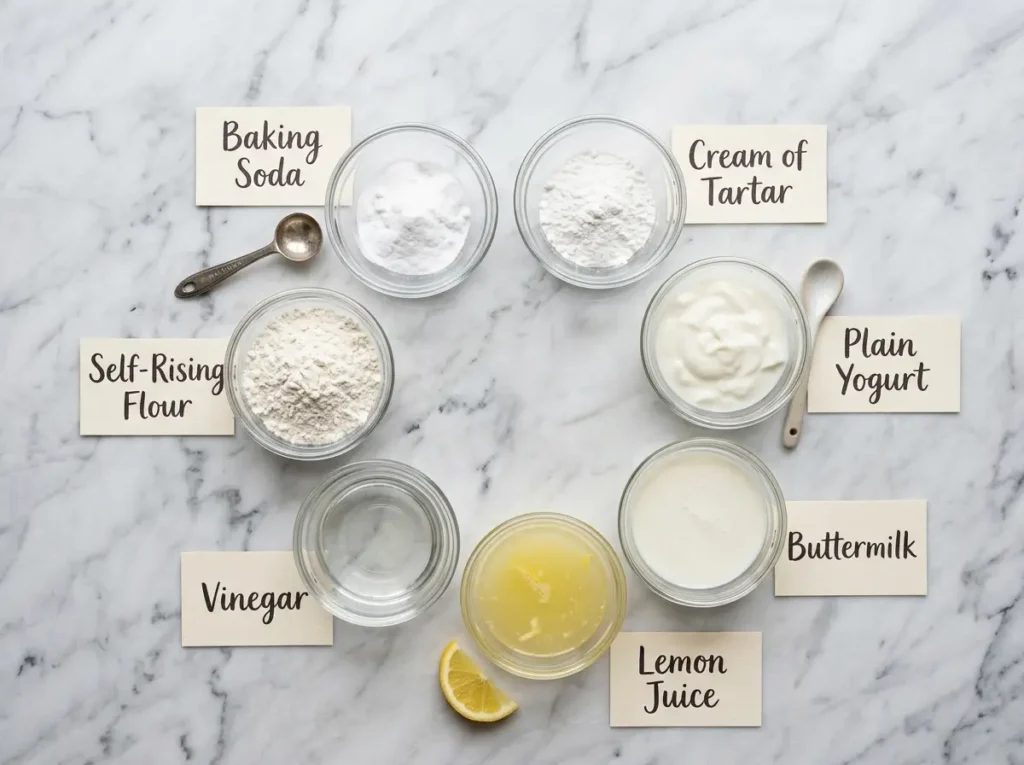
1. Baking Soda + Cream of Tartar (The Gold Standard)
This is my top pick and the one I reach for first. Cream of tartar is a dry acid, which means when you combine it with baking soda, you get almost exactly what commercial baking powder is made of.
Ratio: Replace 1 tsp baking powder with 1/4 tsp baking soda + 1/2 tsp cream of tartar.
Best for: cakes, muffins, biscuits, pancakes — basically anything. No off flavors, no texture changes. This is the one.
2. Baking Soda + Lemon Juice
Lemon juice is acidic enough to activate baking soda, making it a solid substitute in a pinch. The citrus flavor bakes off in most recipes, but in a very mild cake you might catch a faint brightness — which isn’t always a bad thing.
Ratio: 1/4 tsp baking soda + 1/2 tsp fresh lemon juice replaces 1 tsp baking powder.
Best for: lemon muffins, banana bread, fruit-forward quick breads.
I use lemon constantly in wellness drinks — here’s my lemon chia seed water recipe if you want to put that bottle to work after baking.
3. Baking Soda + White Vinegar
Same principle as lemon juice, but even more neutral. Plain white vinegar activates baking soda instantly — you’ll see the fizz. Work quickly once you combine them and get the batter in the pan.
Ratio: 1/4 tsp baking soda + 1/2 tsp white vinegar = 1 tsp baking powder.
Best for: chocolate cake (the vinegar disappears completely behind the cocoa), dark-colored muffins, devil’s food cake.
4. Baking Soda + Plain Yogurt
Plain yogurt is naturally acidic, which means it works double duty: activating the baking soda while also adding moisture and a slightly tangy flavor that pairs beautifully with baked goods.
Ratio: Use 1/4 tsp baking soda for every 1/2 cup of yogurt, and reduce other liquid in the recipe by the same amount.
Best for: muffins, pancakes, loaf cakes. Not ideal for delicate sponge cakes where texture precision matters.
5. Buttermilk + Baking Soda
Buttermilk is one of the most traditional leavening acids in American baking — it’s in every classic Southern biscuit and pancake recipe for a reason. It creates a tender crumb and a beautiful rise.
Ratio: Replace 1 tsp baking powder with 1/2 cup buttermilk + 1/4 tsp baking soda. Reduce your other liquid by 1/2 cup.
Best for: pancakes, waffles, biscuits, quick breads. It’s a liquid substitute, so it requires adjusting the overall recipe liquid.
Don’t have buttermilk either? Make your own: 1 cup milk + 1 tbsp white vinegar, stir, let sit 5 minutes. Done.
6. Self-Rising Flour
Self-rising flour already contains baking powder and salt in measured amounts, so if you’re working on a simple recipe that uses all-purpose flour, you can make the swap directly.
Ratio: Replace all-purpose flour with self-rising flour 1:1, then omit both the baking powder AND the salt from the recipe.
Best for: simple biscuits, shortcakes, pancakes. Avoid for recipes where ratios are very precise (soufflés, choux pastry).
7. Whipped Egg Whites
This is the old-school technique — before chemical leaveners, bakers relied entirely on air trapped in beaten eggs to make cakes rise. It still works beautifully for the right recipes.
How to use: Beat 2–3 egg whites to stiff peaks. Gently fold them into your batter at the very end, after mixing all other ingredients.
Best for: angel food cake, chiffon cake, soufflés, genoise. The texture will be lighter and airier than a chemical-leavened version.
Tips for Using a Baking Powder Substitute Successfully
A few things I’ve learned from testing these swaps in real recipes:
- Mix the acid and baking soda just before using — the CO2 reaction starts immediately with liquid. Don’t let the batter sit.
- Reduce salt slightly if using baking soda on its own, since commercial baking powder is salt-free.
- For delicate recipes (chiffon, layer cakes), stick to cream of tartar — it’s the most chemically similar to commercial baking powder.
- Check expiration dates. Expired baking soda won’t activate properly either. Test it by adding 1/2 tsp to 1/4 cup hot water — it should bubble immediately.
- In high-altitude baking, use slightly less of any leavener — the air pressure difference already gives you a head start.
More Baking Science From the Jello & Wellness Kitchen
Once you get comfortable with substitutions, the whole pantry opens up. Here are a few articles that will help you understand what each ingredient is actually doing in your baking:
- What Does Baking Soda Do in Cookies? — a deep dive into why texture changes so much depending on which leavener you use
| 📌 Sources & Further Reading • King Arthur Baking — Baking Powder Substitutes Guide: kingarthurbaking.com • Serious Eats — The Science of Leavening Agents: seriouseats.com • USDA FoodData Central — Baking Powder Composition: fdc.nal.usda.gov → Ces sources ont une autorité élevée (DA 80+) — elles renforcent le E-E-A-T sur Bing et Google. |
Frequently Asked Questions
Can I substitute baking powder for baking soda?
Yes, but the ratio is not 1:1. Since baking powder contains only about 25% baking soda, you need to use 3x the amount. Replace 1 tsp baking soda with 3 tsp baking powder. Keep in mind this will slightly affect flavor.
What is the best substitute for baking powder?
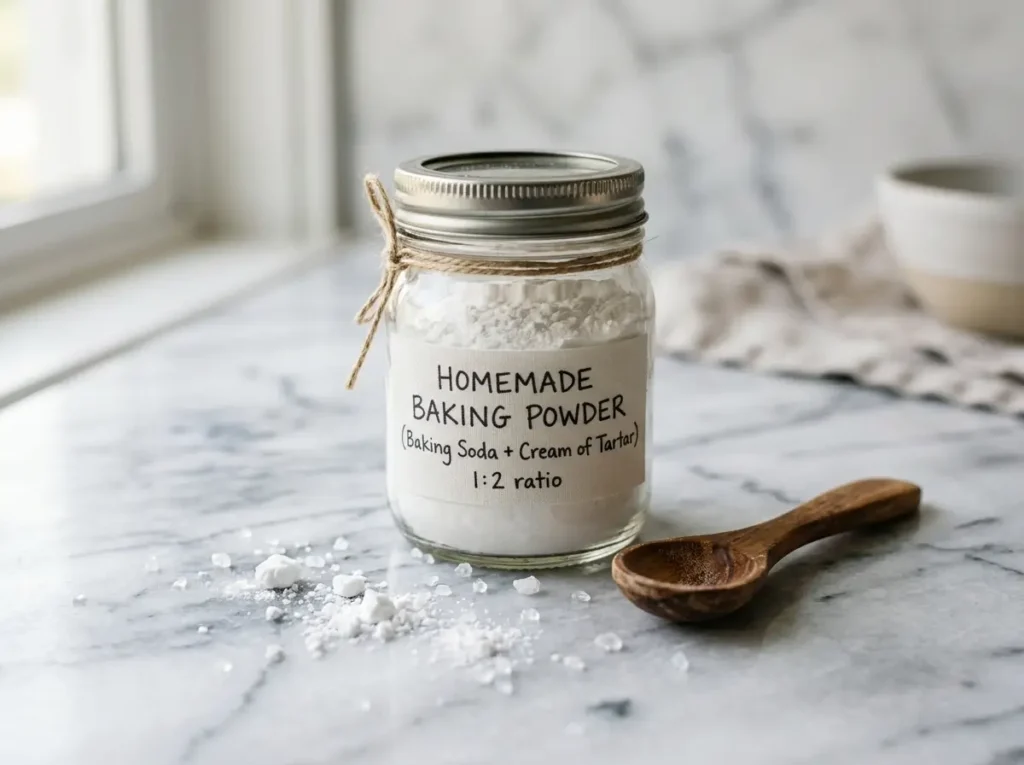
The most reliable substitute is baking soda + cream of tartar. Use 1/4 tsp baking soda + 1/2 tsp cream of tartar to replace 1 tsp baking powder. This combination is chemically equivalent to commercial baking powder.
Can I use self-rising flour instead of baking powder?
Yes. Self-rising flour already contains baking powder and salt. If your recipe calls for all-purpose flour + baking powder, swap to self-rising flour 1:1 and leave out both the baking powder and the salt.
What can I use instead of baking powder in pancakes?
Buttermilk or plain yogurt works well in pancakes. Use 1/2 cup buttermilk per 1 tsp baking powder called for, reduce other liquids by the same amount, and add 1/4 tsp baking soda. The acid in buttermilk reacts to create a light and fluffy texture.
Can I skip baking powder entirely?
Only in recipes that don’t need lift, such as very dense cookies, some bars, or recipes using whipped egg whites for structure. For cakes, muffins, and pancakes, skipping leavening will result in a flat, dense texture.
The Bottom Line
Running out of baking powder is one of those kitchen moments that feels like a disaster but really isn’t. The baking soda + cream of tartar combo is so close to commercial baking powder that in most recipes you simply won’t notice the difference.
For pancakes and muffins, buttermilk or yogurt are my personal favorites — they add moisture and tenderness beyond just the lift. And if you’re baking something light and elegant, the whipped egg white technique is genuinely beautiful.
The key is understanding that baking powder is just an acid + a base + a buffer. Once you know that, every substitution makes perfect sense.
— Hannah Bell, Jello & Wellness